KYC rarely feels like a major expense. It's just a quick ID check, a company registry search and a form to fill in.
But add up all those minutes, for every customer, over a full year. The number quickly becomes bigger than you think.
We ran the numbers on an example.
Our starting point is a mid-sized accounting firm with:
These figures are estimates. Your firm's numbers may differ, but the calculation works the same way.
With manual KYC, this is where the time goes for each new client:
That adds up to two hours per client. With 40 new clients a year, that's 80 hours.
KYC doesn't stop after onboarding. Clients must be monitored on an ongoing basis.
If you review each client once a year and spend half an hour on each, that's 150 hours.
Then there's PEP and sanctions screening. 300 clients with four people each means 1,200 names. At one minute per name, a single round takes 20 hours. If you check every quarter, that's 80 hours a year.
And even that isn't often enough. Sanctions lists are updated far more than four times a year.
Total: 310 hours a year.
That's more than two months of full-time work.
At an internal cost of NOK 800 per hour, that comes to NOK 248,000 a year. If you look at lost billable time at NOK 1,200 per hour instead, the figure is NOK 372,000.
What could your team do with two extra months?
Hours are only part of the picture.
Errors and gaps. Manual processes leave holes. A missed search, an ownership change that wasn't picked up, or an assessment that was never written down.
Supervisory inspections. During an inspection, you need to be able to document what you have done. Missing documentation can lead to orders or administrative fines.
Client experience. New clients who have to email their passport and answer the same questions several times don't get the best start.
Reputational risk. No one wants to be the firm that didn't notice a client was being used for money laundering.
You can use the same formula:
(new clients × time per client) + (number of clients × time on annual review) + (number of names × time per search × number of rounds)
Multiply by your hourly rate, and you have an estimate of what manual KYC costs you today.
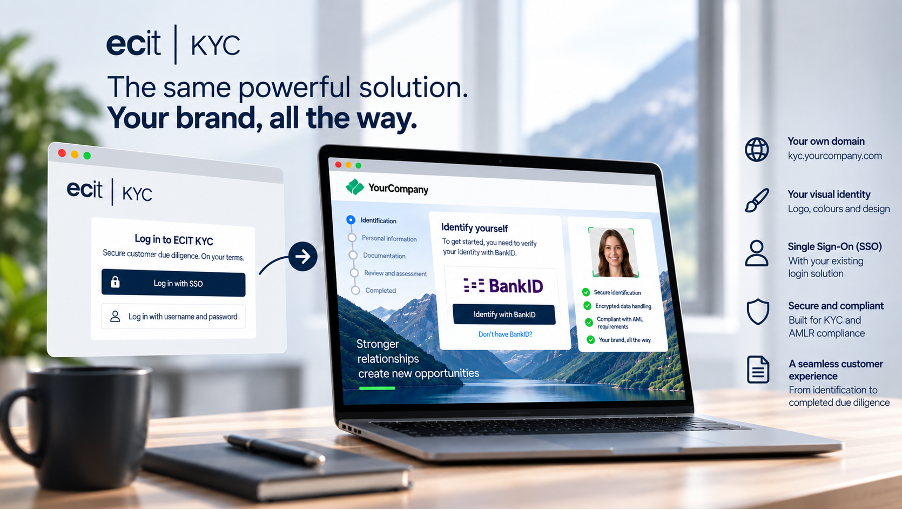
ECIT KYC brings customer identification, beneficial ownership, risk classification, PEP and sanctions screening and documentation together on one platform. With 100% monitoring of your customer base, you no longer need to run manual search rounds, and you can quickly see which clients need follow-up.
That means less time on manual checks, and more time for work that actually creates value for your clients.
How many hours do you spend on KYC today?
Contact us for a demonstration, and we can go through the numbers together.
The calculation is based on estimates and will vary from business to business. This article is general information and not legal advice.