


Know your customer – avoid beingabused by criminals
Money laundering and terrorist financing are no longer just the responsibility of banks or the police – it isa societal problem that undermines the rule of law, weakens institutions and threatens confidence in the economy. In this reality, it is more important than ever to know your customers. With new insights and technology, KYC has become abusiness-critical tool.
A comprehensive societal problem
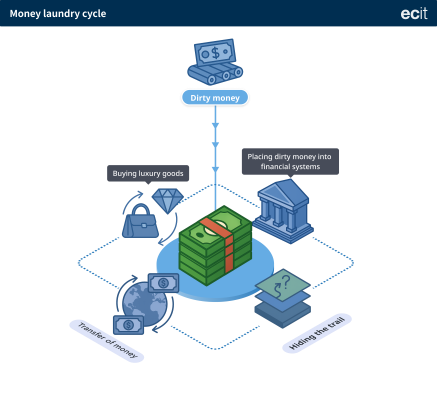
Today, we increasingly see that criminals use legal facades such as companies, property, accounting and legal services to legitimize money from, among other things, tax evasion, fraud,corruption and deceit. According to the UN, up to 5% of the world's GDP can be linked to money laundering.
According to Økokrim's threatassessment for 2024, economic crime is closely linked to organized crime. Over 80% of criminal networks in Europe use legal corporate structures to carry out illegal acts. Økokrim warns that criminal networks are increasingly infiltrating the legal economy – from property and transport to finance and professional services.
The consequences of knowing too little
Poor or inadequate KYC work can have serious legal, financial and reputational consequences. Reporting entities that do not implement sufficient customer measures not only risk fines and sanctions from supervisory authorities – they can also unknowingly be used as tools in criminal networks, contribute to money laundering and, in the worst case, lose the trust of customers, partners and society.
Examples from both Norway and the EU show that businesses that have failed to document customer measures in line with the regulations have been fined millions, lost their licenses or become the subject of police investigations. In addition, notifications and checks can trigger resource-intensive investigations and negative media coverage – even when the company has initially tried to comply with the regulations.
AML work is therefore not justabout compliance. It's about risk management, responsibility, and protectingthe company's long-term reputation and survivability in an increasinglydemanding regulatory landscape.
What do accountants and lawyers have to do with this?
Criminals often use straw men – people who front companies – or so-called “mules” who receive and pass on money without knowing the origin of the funds. This underlines how crucial it is to have thorough checks on both companies and individuals – even when everything on the surface seems legitimate.
Økokrim points out that professional actors such as accountants and lawyers are often used to strengthen the legitimacy of money laundering. Not necessarily becausethey themselves are criminals, but because they are familiar with the regulations, enjoy a high level of trust and can help give transactions and company structures an appearance of legality.
An example of this could be an accountant who sets up several companies for the same client. The companies invoice each other for services that are never delivered, and are used to move money without any real business. The accounts may appear neat and tidy, but behind the transactions lies undeclared work
Similarly,a lawyer can set up client accounts and make money transfers on behalf of so-called "international investors". The funds originate from cryptocurrency and cannot be traced back to legitimate sources, making itpossible to hide the origin and launder the money through seemingly legal processes.
Why KYC is the first line of defense
As explained, money laundering is often hidden behind seemingly legitimate companies and professionals who fail to ask critical questions or obtain the necessary documentation – and who thus risk becoming directly or indirectly involved.
Today, regulations require all reporting entities, such as accountants, real estate agents and banks, to assess each customer based on risk. The higher the risk – the more thorough the measures.
However, checklists and checkboxes are not enough. Effective AML work requires insight, context and technology that makes it possible to uncover patterns, deviations and hidden connections. That is why ECIT is developing a tool that elevates KYC from a statutory obligation to a proactive and strategic resource in the fight against financial crime.
Suspicious activity can be hidden in large amounts of data – which is why account managers, compliance officers and money laundering officers need tools that make it possible to capture what really matters, at the right time.
Technology as a support – not a replacement
Modern technology plays a key role in strengthening compliance. With analytical tools, structured data and automated alerts, it is easier to identify:
• Illogical ownership structures
• Transactions that do not match the business description
• Missing or deviating financial reports
At ECIT, we do not believe in automation for the sake of automation. Our goal is to enhance – not replace –human judgment. When employees are presented with relevant and structured information in a simple way, both the quality and efficiency of their work increase.
For example, the system can automatically retrieve updated ownership data, check politically exposed persons (PEPs) and conduct sanctions searches. At the same time, the responsibility lies with the user to assess the whole and take action when necessary. This creates a better balance between compliance and business operations.
What the solution actually offers
To handle KYC work effectively in practice, businesses need a tool that is both flexible and robust – and that is developed in line with regulations and an increasingly complex threat landscape.
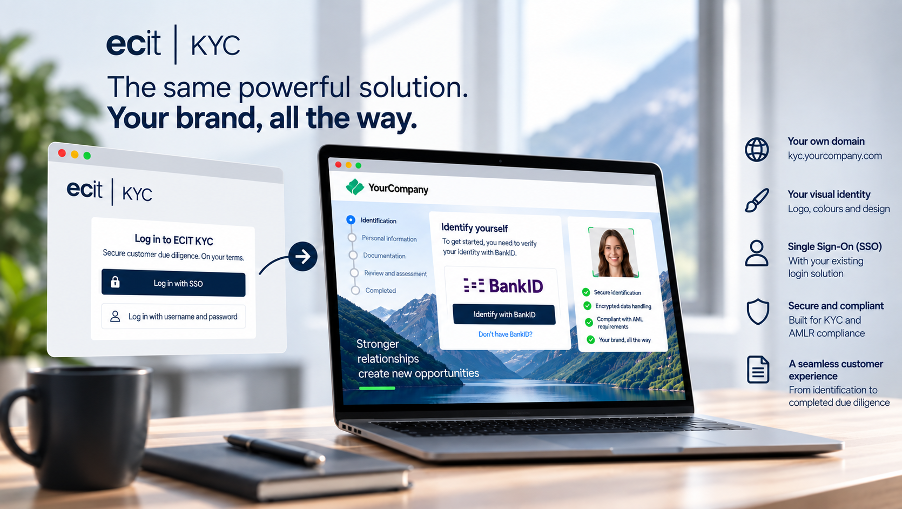
ECIT KYC is a comprehensive platform developed in line with the guidelines of the EU and the FinancialAction Task Force (FATF), and covers the entire customer journey:
• Identification and self-declaration with eID
• Real-time screening against sanctions lists, PEP registers and beneficial owners
• Customer measures and enhanced measures adapted to the risk level
• Risk assessment of both individual customers and the business as a whole
• Documentation and archiving in line with the Money Laundering Act, adapted for supervision and government dialogue
The platform is available in Norway, Sweden and Denmark, and is currently used by over 450 businesses and more than 60,000 end customers. For many, ECIT KYC has become a core tool for fulfilling reporting obligations – and for building trust with customers,authorities and partners.
Ultimately, the question is simple: Do you really know who your customers are? And do you know what you should ask – before someone asks you?
Practical checklist – Do you know your customer?
• Is the customer registered in the Brønnøysund Register (Norway), the Norwegian Companies Registration Office(Sweden) or the CVR Register (Denmark)?
• Are the contact persons and owners real and available?
• Many changes in the customer's board, number of employees, etc.?
• Have we checked the PEP status and sanction lists?
• Has the self-declaration been submitted and does it match the available data?
• Are assessments and documentation stored in line with AML requirements and ready for internal control or supervision?
• Have relevant customer measures been implemented (possibly enhanced measures)?
• Do the accounts and business description support the actual activity and purpose?
• Have we assessed and classified the customer's risk?
By Mikael Leckborn


.png)