


The EU’s new anti-money laundering regulation, AMLR, aims to create more consistent and clearer rules for how businesses prevent money laundering and terrorist financing.
In the EU, the regulation will largely apply from 10 July 2027. For Norway, the regulation is EEA-relevant, and the Norwegian Ministry of Finance has already submitted proposals for national implementation for consultation.
For Norwegian businesses, this means the time to prepare is now.
Much of the framework will be familiar to businesses already subject to anti-money laundering regulations. The major difference is that the EU is bringing key AML requirements into a more harmonised regulatory framework.
This includes increased focus on:
· Risk-based customer due diligence
· Identification of customers and beneficial owners
· PEP and sanctions screening
· Ongoing monitoring of customer relationships
· Documentation of assessments and measures
· The organisation’s own AML risk assessment
AMLA, the EU’s new Anti-Money Laundering Authority, is also developing more detailed standards and guidelines for areas such as customer due diligence, risk assessment and ongoing monitoring.
1. Is your risk assessment up to date?
Your AML risk assessment should reflect your actual customers, services, geographical exposure and other relevant risk factors – and it should actively support your customer due diligence processes.
2. Do you have control of your customer data?
You need to be able to document who the customer is, who ultimately owns or controls the business, and why the customer has been assigned a particular risk classification.
3. Are you monitoring customers over time?
KYC does not end when a customer is onboarded. Information, risk factors and activities can change. Ongoing monitoring will therefore remain an important part of compliance going forward.
4. Can you document what you have done?
Strong AML processes are not only about carrying out checks. You also need to be able to demonstrate which assessments and measures have actually been completed.
The most important step towards AMLR is not to wait for every final detail of the regulation. It is to make sure the right foundations are already in place.
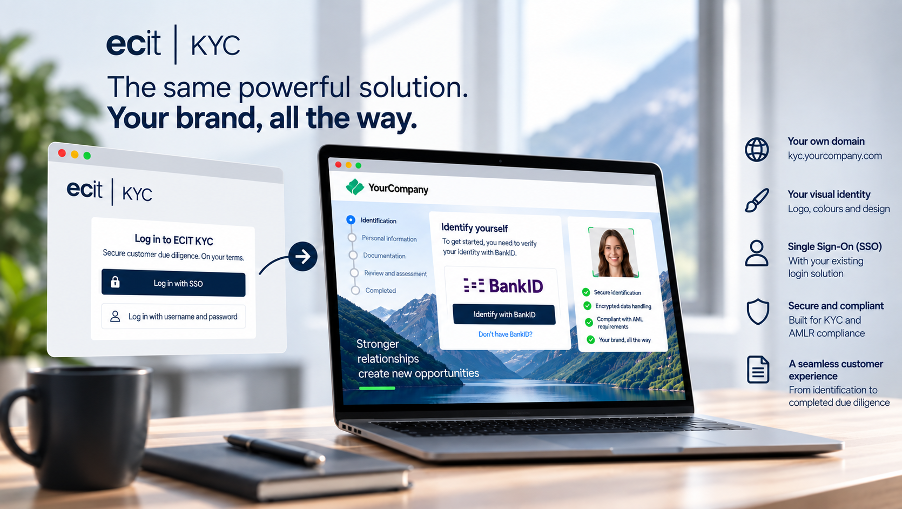
ECIT KYC is built to structure key parts of AML and KYC work, including customer due diligence, risk assessment, screening, beneficial ownership, documentation and ongoing monitoring.
This means we are already ready to help businesses prepare their KYC and AML processes for the requirements ahead.
At the same time, we continue to develop ECIT KYC as AMLR and the technical requirements become more clearly defined.
AMLR does not necessarily mean that everything your business does today needs to be rebuilt. But it is a good opportunity to ask:
Do we have control of our customers, our risks and our documentation – even as our customer base grows?
If the answer is not a clear yes, now is a good time to start.
Would you like to see how ECIT KYC can help your business prepare for AMLR?
Contact us and we will show you how to structure your KYC and AML processes today.
This article is intended for general information purposes only and should not be considered legal advice.


.png)